
IS THE OLD TESTAMENT STILL TRUE?

Updated: Aug 16
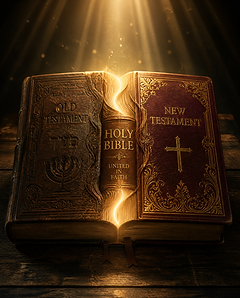
There is a quiet shift happening in parts of the modern church. You can see it in the way some churches soften Scripture, avoid certain passages, or treat the Old Testament as less important than the New. Most believers would never say the Old Testament is invalid, but many have begun to treat it as optional — something God once said, but no longer expects us to follow.
But Paul writes in 2 Timothy 3:16:
“All Scripture is inspired by God and profitable for teaching… and for training in righteousness.”
When Paul wrote those words, “Scripture” meant the Old Testament. The New Testament had not yet been assembled. Paul is telling us that the Old Testament still speaks with authority, still teaches, still corrects, and still reveals the heart of God.
In Leviticus, God gives Moses His laws. They are direct. They are clear. They are not softened. They reveal the seriousness of holiness and the weight of sin. Modern Christianity often avoids these passages because they make us uncomfortable, but discomfort does not make Scripture obsolete.
Yet in the same book, God establishes mercy. He gives the priest authority to bring the sins of the people before Him. He consecrates bread as holy. He anoints the high priest with oil. The Old Testament is not a relic. It is the foundation of the Way.
When Moses stands before Israel in Deuteronomy and delivers his final sermons, he does not offer suggestions. He offers revelation. He tells the people to walk in the ways the Lord has commanded, to teach these things to their children, and to remember the God who brought them out. He says something remarkable:
“What great nation is there that has a god so near to it as the Lord our God is to us whenever we call upon Him?” — Deuteronomy 4:7
The Way was always meant to be visible. It was always meant to extend beyond Israel. It was always meant to be walked. Jesus did not abolish the Way. He fulfilled it. He walked it so completely that the road itself could be seen in His life. “I am the Way,” He said — not to exclude, but to direct.
Here is the road. Walk on it.
Reflection for Today: Ask yourself honestly: Have I treated any part of God’s Word as optional? Have I softened anything He has spoken because it feels uncomfortable in today’s culture?
The Old Testament is not obsolete. It is not harsh. It is not irrelevant. It is the beginning of the Way. And the Way still stands.
To understand why the Way still stands, we have to look at how the New Covenant actually works — not how people often misuse it. The word “testament” simply means “covenant.” The Bible uses the word covenant, so that is the word used here.
Today, many people hold a false belief about the New Covenant. They use it to justify ignoring the moral laws God gave to Moses in Leviticus. They claim that because Jesus paid the price for our redemption, He replaced the moral boundaries with a new standard. But this is not what Scripture teaches.
The laws in Leviticus reveal God’s holiness. They show what is right, what is destructive, and what separates a person from the life God intends. Those moral truths have not changed. What changed under the New Covenant is not the moral standard, but the way God deals with the consequences of breaking it.
Ancient Israel lived under a civil system where sin carried legal penalties. The Church does not enforce those penalties because Jesus fulfilled the covenant that required them. But His fulfillment did not erase the moral truth behind the law. It removed the punishment, not the holiness.
Grace does not redefine sin. Grace redeems the sinner.
Jesus paid the price for our redemption, but He did not declare that everything God once called destructive is now acceptable. The moral boundaries in Leviticus still stand because they reflect God’s character, not ancient culture. The civil punishments ended because the Church is not a nation-state. The ceremonial rituals ended because Christ completed them. But the Way — the life God calls His people to walk — remains.
Forgiveness does not give permission to ignore the Way. It gives strength to walk it.
The laws given in Leviticus were never a single, uniform set of commands meant to be applied in the same way for all time. They were a collection of different kinds of laws, each serving a distinct purpose in the life of ancient Israel. Some laws expressed God’s moral character — commands that reveal what is right, just, and holy in every generation. Other laws governed Israel as a nation, providing civil and judicial structure for a people living in a specific time and place. Still others were ceremonial, shaping the worship life of Israel through sacrifices, priestly duties, and rituals connected to the Tabernacle.
Understanding these distinctions matters. The moral laws reflect God’s nature and do not change. The civil laws were for Israel’s governance and do not apply to modern society. The ceremonial laws pointed forward to Christ and were fulfilled in Him. When Jesus said He came not to abolish the Law but to fulfill it, He was naming this reality. He completed the sacrificial system, replaced the civil structure of ancient Israel, and reaffirmed the moral heart of God’s commands.
This is why we no longer carry out civil penalties such as stoning, yet we still recognize the seriousness of the moral truths behind those laws. God does not expect us to enforce ancient punishments, but He does expect us to honor the holiness those laws were meant to protect.
The mistake of modern interpretation is not that it rejects civil or ceremonial laws — Scripture itself shows they were temporary — but that it often softens or redefines the moral ones. The challenge today is to hold firmly to what reflects God’s character and to walk the Way Christ fulfilled, without misusing the Old Testament to justify actions or attitudes that contradict the life He calls us to live.


Comments